TL;DR
How F&O income joins your other income
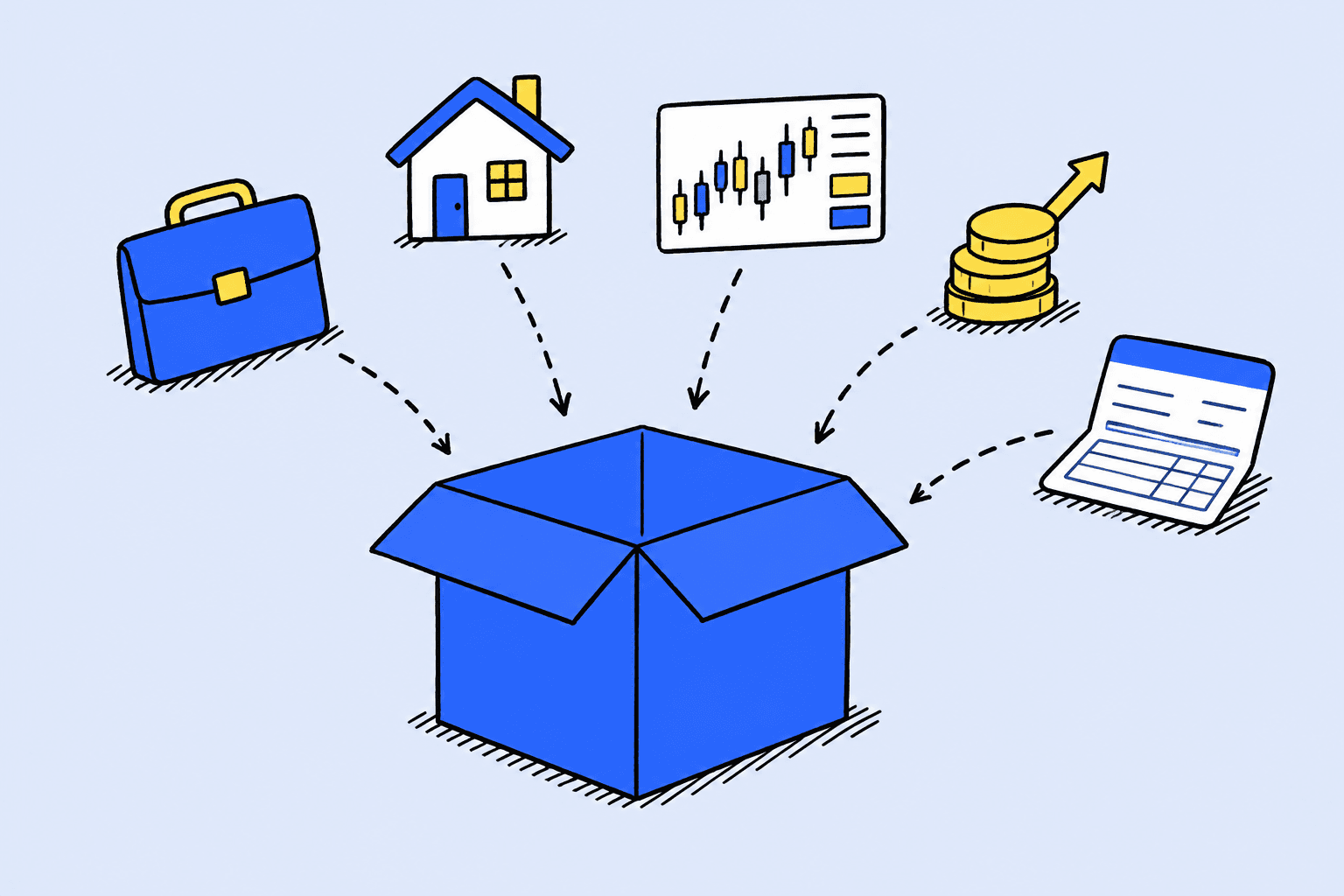
Your tax depends on your total income, not on F&O alone. The Act groups income under five heads: salary, house property, business or profession, capital gains and other sources. F&O profit goes under business or profession. You add it to your income under the other heads.
How each other income is counted
Salary: your gross salary less the standard deduction. The standard deduction is ₹75,000 under the new regime and ₹50,000 under the old regime. This is Section 19 of the 2025 Act (Section 16 of the 1961 Act). It applies to salary only, not to F&O income.
Rent: rent from a house you own goes under house property. You get a deduction of 30% of the annual value. This is Section 22 of the 2025 Act (Section 24 of the 1961 Act). The annual value is usually the rent you receive, less municipal taxes you paid.
Interest: interest on savings accounts and fixed deposits goes under other sources. You add it in full.
Capital gains: listed shares have their own rates. Short-term gains pay 20%. Long-term gains pay 12.5% on the amount above ₹1.25 lakh in a Tax Year. These are Sections 196 and 198 of the 2025 Act (Sections 111A and 112A of the 1961 Act).
F&O profit is not a capital gain, so the share rates do not apply to it.
How slab rates apply to the total
Slab rates tax each slice of income at its own rate. F&O profit has no separate rate. Each rupee of it is taxed at the rate of the slab it reaches.
The new regime is the default for Tax Year 2026-27, which runs from 1st Apr 2026 to 31st Mar 2027. Its slabs start at nil up to ₹4 lakh and reach 30% above ₹24 lakh. This is Section 202 of the 2025 Act (Section 115BAC of the 1961 Act). Add 4% cess to the tax.
A resident individual gets a rebate if total income is up to ₹12 lakh. This is Section 156 of the 2025 Act (Section 87A of the 1961 Act). The rebate cancels slab tax up to ₹60,000. It does not apply to tax on capital gains at their own rates. Above ₹12 lakh, marginal relief limits the slab tax to the amount of income above ₹12 lakh.
A worked example
Example
Meera earns a salary, rent, interest, F&O profit and a share gain
Salary ₹8,00,000, less standard deduction ₹75,000: ₹7,25,000
Rent ₹2,00,000, less 30% (₹60,000): ₹1,40,000
Bank interest: ₹40,000
Net F&O profit: ₹4,00,000
Income at slab rates: ₹13,05,000
Slab tax on ₹13,05,000: 5% of ₹4,00,000 (₹20,000) + 10% of ₹4,00,000 (₹40,000) + 15% of ₹1,05,000 (₹15,750) = ₹75,750. No rebate applies, because her total income is above ₹12 lakh.
Long-term gain on listed shares: ₹2,25,000. Less ₹1,25,000 gives ₹1,00,000. At 12.5%, the tax is ₹12,500.
Tax before cess: ₹75,750 + ₹12,500 = ₹88,250. Cess at 4% is ₹3,530. Total tax: ₹91,780.
Without the F&O profit, Meera’s slab income would be ₹9,05,000 and her total income ₹11,30,000. The rebate would cancel her slab tax. The F&O profit costs her the full ₹75,750 before cess, because it also removes the rebate.
Regime points for a trader with other income
The new regime is the default. If you have business income, you can opt for the old regime. The option has limits. They are in Section 202(4) of the 2025 Act (Section 115BAC(6) of the 1961 Act). Three points matter for a trader:
Make the choice in your return, and file it by the due date.
You can withdraw the choice only once. After that, you cannot choose the old regime again while you have business income.
The old regime allows most deductions, such as Section 123 of the 2025 Act (Section 80C of the 1961 Act). It has a lower standard deduction and different slabs.
Compare both regimes on your own figures before you choose.
An F&O loss can reduce your rent, interest and capital gains in the same year. It cannot reduce your salary (Section 109 of the 2025 Act; Section 71 of the 1961 Act).
Watch out
What to do next
Collect your Form 16, rent records, interest certificates and share gain statement.
Calculate your F&O profit from your broker’s tax P&L.
Check if you must pay advance tax during the year.
Key takeaways
F&O profit joins your salary, rent and interest, and slab rates apply to the total.
Capital gains on listed shares are taxed at their own rates, apart from the slab total.
A person with business income who withdraws the old regime choice cannot make it again while they have business income.
General information, not tax advice. Rules change, so check with a CA before you act.