
Check Company Registration

Enter a company or LLP name to find every matching entity on the MCA register, with its CIN or LLPIN.
Powered by

What does an MCA company name search return?
Searching a name against the Ministry of Corporate Affairs register returns every registered company and LLP whose name matches what you typed, each with its identification number: a CIN for companies, an LLPIN for LLPs.
The search matches partial names. Entering "Sandbox" returns every registered entity containing that word, companies and LLPs together.
Selecting a result opens that entity's full MCA master data, including status, incorporation date, registered office and capital structure.
What is a Corporate Identification Number (CIN)?
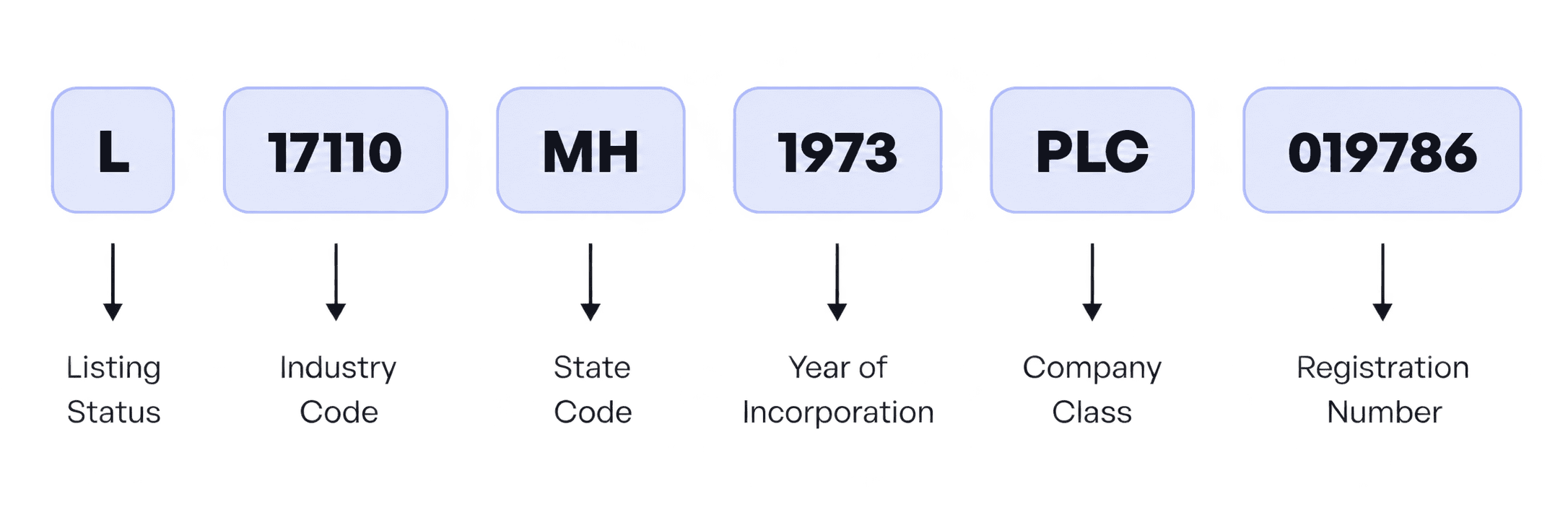
A Corporate Identification Number follows a standard 21-character format, where each part carries specific information about the company:
1st character – Listing status: L for listed, U for unlisted
Characters 2–6 – Industry code based on the National Industrial Classification (NIC)
Characters 7–8 – State code where the registered office is located
Characters 9–12 – Year of incorporation
Characters 13–15 – Company class: PTC for private, PLC for public, OPC for one person company
Characters 16–21 – Serial registration number assigned by the ROC
Reading the CIN tells you the state and year of registration before you open the full record — useful when several search results have similar names.
Under Section 12(3)(c) of the Companies Act, 2013, every company must quote its CIN on invoices, letterheads, and official communications — which is why the number already appears on documents you have.
What is an LLPIN?
An LLPIN is a 7-character identifier in the format AAA-0000. Unlike a CIN, it doesn't encode information — it is a sequential number issued by the ROC, with no listing status, industry code, or state code embedded in it. For LLPs, open the record to see the state and incorporation date.
LLPINs are issued under the Limited Liability Partnership Act, 2008.
How to pick the right entity from your results
Because the search matches partial names, a common word returns many results. MCA also permits registered names that differ only slightly, so near-identical matches are normal. Work through them this way:
Match the legal suffix exactly. "Private Limited", "Limited", and "LLP" are separate legal entities, not variations of one. An invoice from Sandbox Creative LLP is not from Sandbox Creative Private Limited.
Read the state code in the CIN. Characters 7–8 carry the state of registration — GJ, KA, DL, TN. If you know where the entity operates, this narrows the list immediately.
Read the incorporation year. Characters 9–12 give the year of registration. An entity claiming fifteen years of operation shouldn't have a 2024 CIN.
Check the company class. PTC, PLC, and OPC at characters 13–15 tell you whether it's a private company, public company, or one person company.
If two matches remain indistinguishable, select both and compare the registered office address against the address the entity gave you.
When a company registration check returns no results
An empty result doesn't by itself mean the entity is unregistered. Check these first:
Spelling and word order — the register matches the name as recorded, not phonetically
Trade name vs registered name — the brand a business trades under is often not its registered name. Quicko trades as Quicko Infosoft Private Limited.
Entity type — sole proprietorships and traditional partnership firms aren't registered with MCA at all, so they never appear here regardless of spelling
Recent incorporation — an entity registered in the last few days may not yet be reflected
Try the single most distinctive word in the name on its own. Because the search matches partial names, a shorter query returns more.